
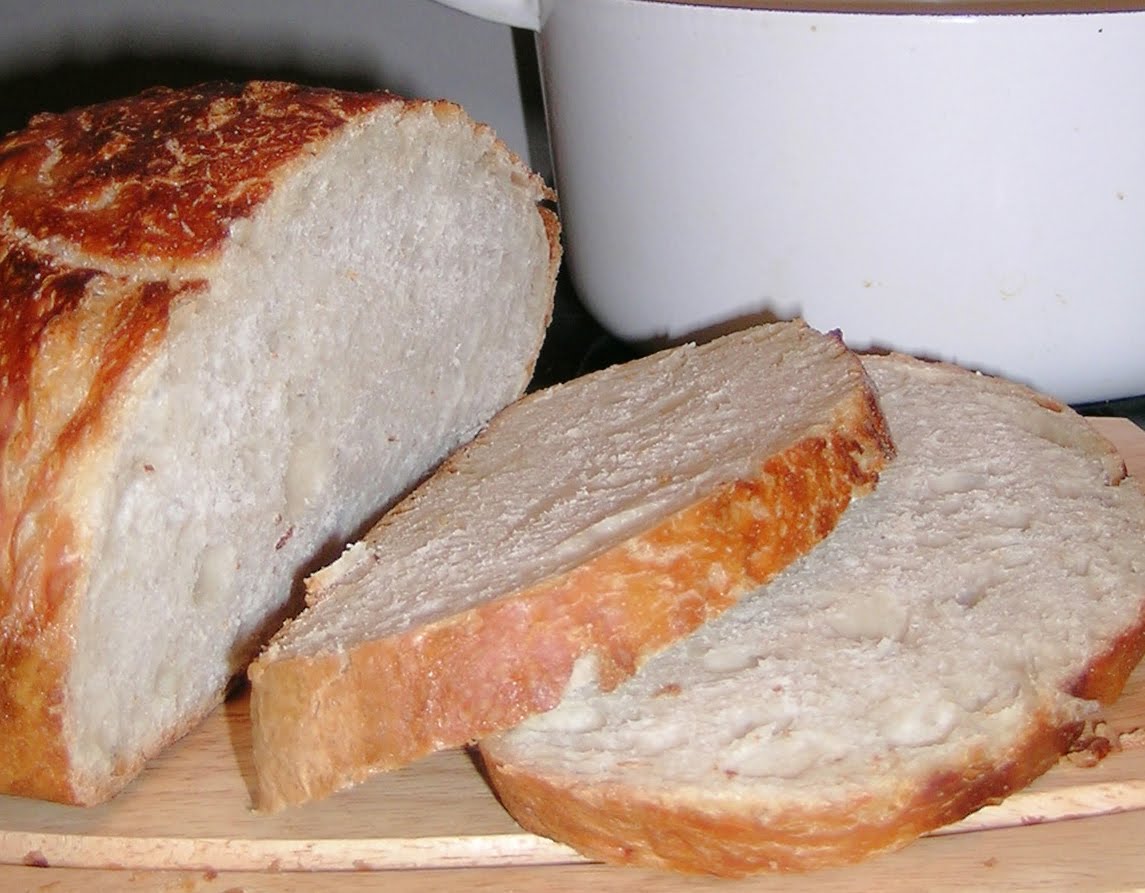
 It’s hard to believe that more than four years have passed since New York Times columnist Mark Bittman turned the home bread baking world upside down with his story on Jim Lahey’s crusty, tasty, no-knead pot bread. Thousands of foodies have since tried various “kneadless,” methods, and interest in them stills seem high. (Go to my crusty white pot bread recipe, pictured, or to details on the very durable, economical cast iron pot .) Or find more info here.) The question I’ve been raising with my food colleagues lately is whether no-knead is a fad or here to stay? (The results of a survey presented below give strong clues!) As an author of my own book on the subject, Kneadlessly Simple, I, of course, hope it not only lasts but that even more home bakers will jump on board as word of its ease and good results spread. (Click for details on what pot to use.) The food pros’ answers to the question are mixed, though the majority seem to think the method is going to last. One “kneadless” fan said he adapted a version to his own sourdough starter, and “loved it.” Said another advocate: “The no-knead technique is a godsend to busy cooks who want real food with less work.” In contrast, a naysayer commented, “It’s a fad—at least I certainly hope so.” Still another colleague volunteered that while he thinks kneadless is here to stay, his fiancée still wants him “to make ‘real’ bread.”
 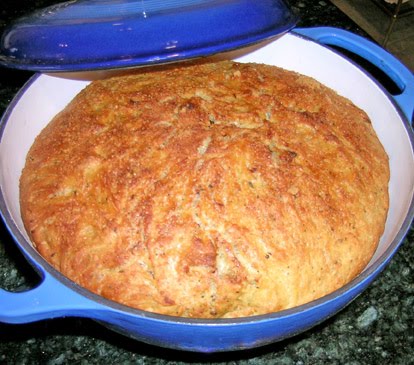 I suspect that this last comment reflects the completely mistaken notion that the no-knead method skips the kneading—and therefore can’t make fine bread. In fact, the dough just sits and slowly kneads itself as the natural bubbling action of the yeast shifts it around. (While this happens, wonderful flavor develops, too.) Or, perhaps it reflects the notion that the old way is always better, which is ironic considering that no-knead was the original way, and that kneading was a shortcut bakers came up with to artificially accelerate the natural process. (The snapshot on the left is my roasted garlic-parmesan bread from Kneadessly Simple.)
Survey of Home Bread Bakers
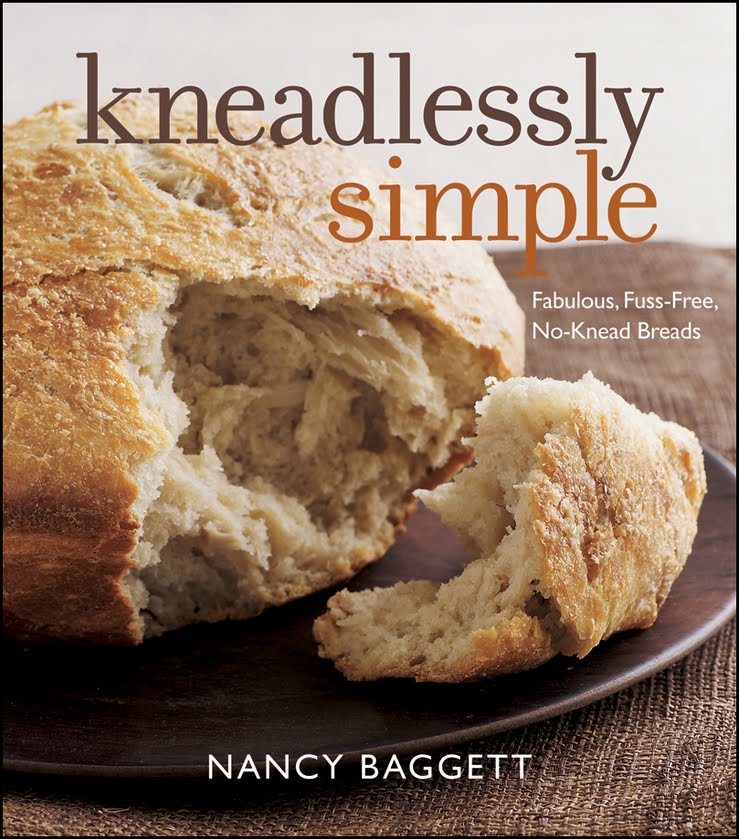 The results of a fascinating survey conducted for Fleischmann’s yeast of its customers who tried some of my Kneadlesssly Simple recipes sheds a lot of light on the question. (Note that I had no knowledge whatsoever that the survey was being conducted.) While many home bakers apparently started out a bit skeptical, the overwhelming majority were sold after trying the approach: Counting both the respondents who said they were switching to no-knead recipes exclusively and those who planned to use them occasionally, a whopping 97.9 % said they would use the recipes again. Obviously, I was thrilled with this news!
 Here are some other survey findings, all provided courtesy of Fleischmann’s. The results strongly suggest that no-knead is around for the duration. (BTW, the Cheddar & Chiles bread, pic below right, was one those tested in the survey.) Compared to your expectations how would you rate the recipes?
1.1% Significantly worse than I expected.
5.3% Somewhat worse than I expected.
25.0% What I expected.
36.0% Somewhat better than I expected.
32.6% Significantly better than I expected.
How Did You Like the Recipes?
2.4% Very Dissatisfied/Dissatisfied
8.6% Neutral
37.8% Satisfied
51.2% Very Satisfied
Impact of Ease/Convenience on Your Baking Habits
16.4% No-knead will not affect my amount of baking.
18.9% No-knead will increase my amount of baking by 10%.
26.4% No-knead will increase my amount of baking by 25%.
38.8% No-knead will increase my amount of baking 50% or more.








You are absolutely right. The "sourdoughs" who were prospecting for gold often kept a dough going so that it was "self-kneading," all the time, and most didn't bother kneading other than to just mix things together. They also baked in a lidded cook pot set in the fire, so this isn't novel either!
I'll check out your comments- thanks.
When the no knead stuff hit home baking circles you would have thought that someone had just discovered fire. I have absolutely nothing against the no knead stuff, in fact I welcome it as an additional technique. But really they have been around for many years in many guises. It just too Mark to write about it to bring it to the foreground. My own thoughts on No Knead here
http://attheveryyeast.com/2009/05/thoughts-on-no-knead-recipes/
Heather, that is wonderful to hear. I envisioned this method enabling folks to make homemade bread without having to clear a whole day to work on it–instead just doing a few steps in between other things. Sounds like that's how you are using the recipes–great!
All I know is that I bake every week, sometimes twice, using your recipes and methods. I am a convert. I love the convenience and the outstanding flavor and the consistent results that I get, which I never did get with kneading or using the mixer. Do whatever works for you, but I think that those that knock it just haven't tried it.
Cynthia, excellent question. Noted yeast/bread chemist Dr. Carl Hoseney told me that during visits to isolated parts of the world (where no power equipment has arrived) he has seen bakers making bread as they did centuries ago–by stirring together flour, salt, yeast, and water with a big paddle or stick, & just letting it ferment for a day or so. They then pull off workable portions, let them rise, & bake. Good bread, he says!
I would like you to expound more on how you figured No-Knead WAS the first bread. Thanks Nancy.
Thanks for your thoughtful comments–right on both counts. The no-knead replicates the slow rise bakers recommend, plus baking in a pot gives home bakers a way to replicate the commercial steam-jetted oven.
As you stated in the post, from what I understand, traditionally breadmaking allowed for a slow rise to develop the great flavor. The no-knead method replicates that with the added bonus of not having to knead it.
In addition, the concept of baking in a large cast iron dutch oven is perfect for home bakers who don't have access to a commercial kitchen to make that great crust. I don't see the method going away, I just see it evolving as people start experimenting with their own starters, their own flour mixes and their own additions the dough.